



Designing safe, cost-efficient foundations in the UAE starts with choosing the right investigation plan — then executing it through a civil material testing laboratory that understands local soils: desert sand, sabkha, reclaimed fills, and shallow coastal groundwater.
This version breaks down the essentials your consultant or contractor expects on any UAE geotechnical scope, without drowning the reader in checklists.
SPT vs CPT: When Each Test Makes Sense
- SPT (Standard Penetration Test)
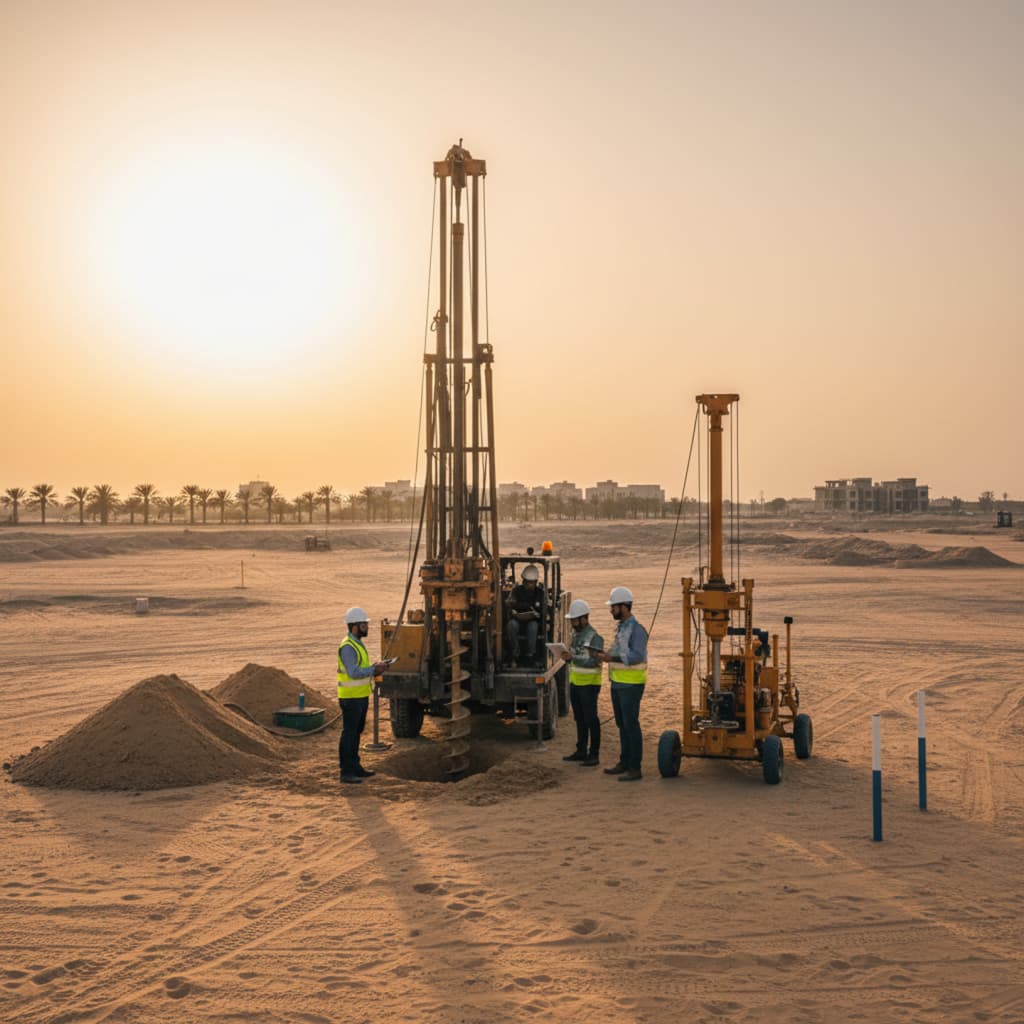
SPT remains the most common in the UAE because it works reliably in mixed fills and granular soils. It’s performed inside machine-drilled boreholes and gives the familiar N-values used to understand density, layering, and relative strength.
For reclaimed areas or older urban plots where soil conditions shift frequently, SPT helps map those variations clearly.
- CPT (Cone Penetration Test)
CPT is the higher-resolution alternative, providing continuous profiling as the cone advances. Clean sands and interlayered deposits — typical across Dubai and Abu Dhabi — benefit from CPT’s QC and sleeve friction readings. It’s fast, repeatable, and extremely useful for settlement predictions and pile capacity calculations.
Most projects use a combination: boreholes with SPT for stratification, and CPT soundings to fill gaps between points and sharpen design parameters.
Boreholes, Depth Planning & Groundwater
Borehole depth and spacing depend on footprint and load. High-rise towers, tanks, and deep basements need deeper boreholes; villas and warehouses typically need shallower but closer-spaced locations.
In coastal zones, groundwater readings become a major design input, and many consultants request additional standpipes or piezometers to observe fluctuations — especially where sabkha or seasonal tides influence the water table.
Accurate logging of lithology, cementation, moisture, and any perched water layers is essential for approvals.
Lab Testing: What a Good Civil Material Testing Laboratory Delivers
Lab programmes are always tailored to the soil encountered on site, but the core tests stay consistent:
- Index properties (moisture, particle size, specific gravity, Atterberg limits) define the soil classification and behaviour.
- Strength and compressibility tests — such as triaxial, direct shear, oedometer, or CBR — support bearing capacity, settlement predictions, and pavement design.
- Chemical tests for chlorides, sulphates, and salinity guide durability decisions for concrete mixes, cover thickness, and protective barriers.
- Accredited labs (ISO 17025) also supply full documentation for traceability — something UAE consultants and authorities expect.
From Data to Design: Correlations That Matter
This is where field and lab data connect to real design decisions.
- Shallow Foundations
Engineers use density, plasticity, SPT N-values, CPT qc profiles, and consolidation results to estimate bearing capacity and settlement. These correlations are well-established and widely used across the GCC.
- Deep Foundations (Piles)
CPT is particularly valuable for assessing shaft and base resistance layer by layer. Most UAE projects still validate theoretical capacities using preliminary pile load tests or PDA testing, especially for high-load structures.
- Durability
Soil and groundwater chemistry directly inform the concrete class, mix design, and cover recommendations — a critical part of foundation design in sulphate-rich or coastal environments.
Reporting: What Consultants Want to See
Clear, structured reporting is what speeds up approval cycles. A strong report includes:
- A unified soil profile with SPT logs, CPT traces, and groundwater information
- Design-ready parameters (φ, c, γ, Es, mv, k) summarised by layer
- Foundation recommendations — including type, depth, allowable bearing, estimated settlements, and pile design envelope
- Proper traceability: sampling plan, calibrations, photos, and chain of custody
When prepared by an ISO 17025-accredited civil material testing laboratory, the submission process is usually smoother and faster.
Need a geotechnical scope and drilling schedule? We’ll map the right combination of boreholes, SPT/CPT, and lab tests for your site anywhere in the UAE.
FAQs
How many boreholes does a UAE plot need?
It depends on foundation loads, footprint size, and soil variability. Larger or more variable sites require more data points, often supplemented with CPT.
How often is SPT conducted within a borehole?
Typically, every 1.5–2 metres, with additional tests near anticipated founding levels.
What deliverables do consultants expect?
Logs, CPT traces, lab reports, groundwater data, and clearly explained design parameters tied to foundation recommendations.